13th Dec '25

Fission and Fusion

The splitting up of the nucleus is known as nuclear . Nuclear reactors use uranium 235 as a fuel. For fission to occur the uranium 235 or plutonium 239 nucleus must first absorb a .

The nucleus undergoing fission splits into two smaller nuclei and 2 or 3 neutrons, releasing energy. The neutrons may go on to hit another nuclei causing them to split and so continuing the reaction. This is known as a chain reaction.
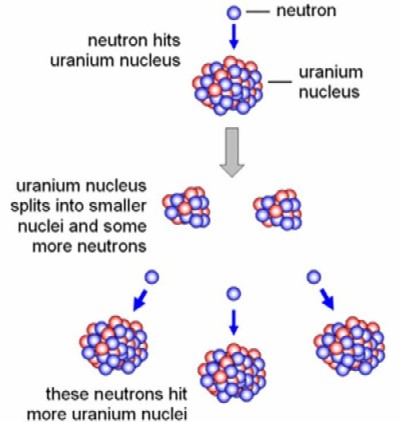
A chain reaction can be expressed in the following nuclear equation (products can vary):

235 U + 1 n Kr + 141 Ba + 3 1
92 0 36 0

Inside a nuclear reactor the chain reaction is controlled by 'control rods'. These control rods are placed in between the fuel rods. They absorb neutrons, stopping them continuing the chain reaction.

If the rate of the chain reaction needs to be increase, the control rods are raised, so neutrons are abosrbed. If the reaction needs to be slowed then the conrol rods are lowered to absorb neutrons.

Once the desired rate of reaction is reached, the control rods are placed so that they absorb all but one of the neutrons created during each fission event. This creates a stable, self sustaining chain reaction.

There is also a process known as nuclear which occurs naturally under the huge gravity conditions within a . During fusion two nuclei are forced together forming a one which also releases energy.

Some scientist have claimed to have produced energy from ‘cold fusion’. This is fusion at temperatures a little above room temperature. Cold fusion is not an accepted scientific theory because independant scientists have not been able to reproduce the orginal experiment. Scientific theories are not accepted until they have been validated by the scientific community.


Find out more: